Binance Smart Chain !?
An enormous, cheap, genuinely useful EVM chain with the best distribution funnel in crypto — and a validator set and treasury whose fate is inseparable from a single company.
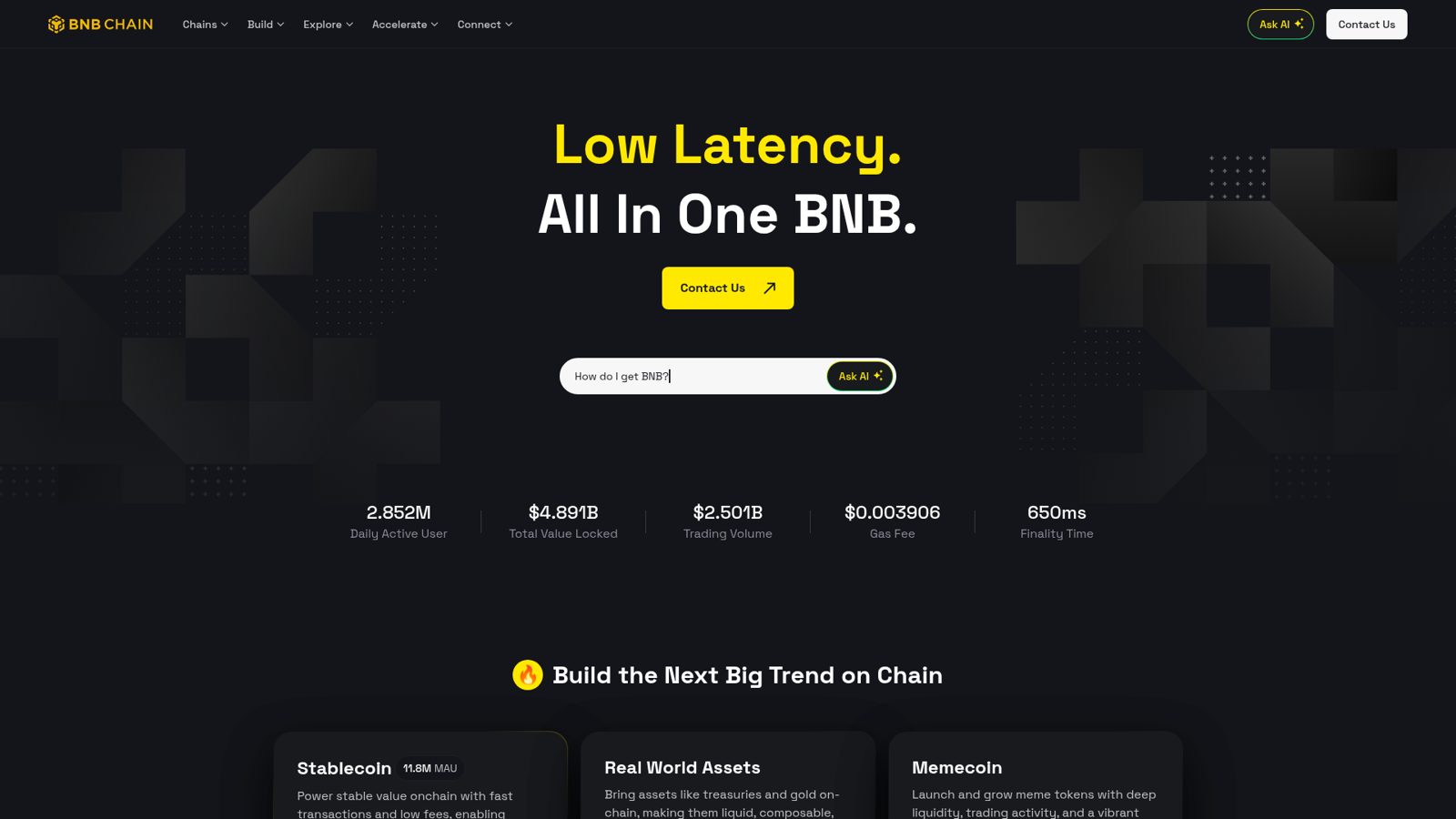
BNB Chain is the clearest example in this archive of the trade-off at the heart of blockchain design being resolved almost entirely in favour of performance and distribution. It is fast, it is cheap, it has an enormous user base, and it is EVM-compatible so the entire Ethereum toolchain works out of the box. It is also, in every meaningful sense, an exchange-aligned chain: its validator set is small, its most important applications are Binance-adjacent, and its token's value is entangled with the fortunes of the largest centralised exchange on earth. Both halves of that sentence are load-bearing.
Take the strengths seriously first, because the reflexive dismissal from Ethereum-native analysts is lazy. BNB Chain settles an extraordinary number of transactions per day at fees measured in cents, with block times fast enough for consumer applications. Its ecosystem is real: PancakeSwap has been a top decentralised exchange by volume for years, the chain hosts substantial stablecoin liquidity, and it has been a consistent home for retail-facing applications — games, launchpads, meme markets, yield products — that never found traction elsewhere. The opBNB layer two and the Greenfield storage network extended the stack rather than merely rebranding it.
The distribution advantage is the thing no competitor can buy. Binance's exchange has hundreds of millions of registered users, and BNB Chain sits one tap away inside that funnel: withdraw to the chain for a fraction of the cost of Ethereum, and the wallet, the on-ramp, the fiat corridors and the customer support are all already there. For an ordinary user in Southeast Asia, the Middle East or Latin America, this is the path of least resistance into on-chain activity by an enormous margin. Crypto's persistent complaint is that it cannot reach normal people. BNB Chain reaches them, in volume, every day.
BNB itself is one of the few tokens in this asset class with a legible, non-circular value story. It pays reduced trading fees on the exchange, it is the gas token of the chain, it collateralises a broad DeFi ecosystem, and its supply is reduced by a quarterly auto-burn mechanism formula-linked to price and on-chain block production, with a published target of reducing supply toward 100 million. The burn has executed consistently for years and is verifiable. Whatever else is true, the tokenomics are transparent and the deflation is real rather than rhetorical.
Now the compromises. The validator set is small — a few dozen active validators elected by stake, with the largest holdings historically associated with the exchange and its affiliates. That is enough decentralisation to distribute block production and far too little to resist a determined authority acting on the entity that anchors it. The chain has, on more than one occasion, coordinated a halt: most notably after the October 2022 cross-chain bridge exploit, when roughly two million BNB were minted fraudulently and the network was paused to contain the damage. The pause worked. It also proved definitively that the chain has an off switch and a small group who can reach it.
That bridge exploit remains the single largest technical failure on the record, and it belongs in the assessment permanently. The vulnerability was in the cross-chain proof verification, the exploit was worth hundreds of millions at nominal value, and containment depended on social coordination rather than protocol design. Since then, security practices have improved substantially — audits, bounty programs, a hardened bridge architecture and faster incident response — but the incident established the operating model: when something breaks, humans intervene. On a chain marketed to retail users as decentralised finance, that gap between marketing and mechanism matters.
Regulatory history is the second overhang. Binance's 2023 settlement with United States authorities involved a multi-billion dollar penalty, a criminal plea by the corporate entity, the departure of its founder from the CEO role, and the installation of ongoing compliance monitoring. The company has since operated as a considerably more conventional regulated business, which arguably reduces forward risk. But the chain's fate is still coupled to a single corporate entity's regulatory standing in a way that Ethereum's, Bitcoin's, or even Solana's is not. Correlated risk of that kind cannot be diversified away by holding more BNB.
Application quality is uneven and deserves a candid word. The low-fee, high-throughput, retail-heavy profile that makes BNB Chain accessible also makes it the most efficient venue in crypto for low-effort token launches, honeypots and rug pulls. The chain hosts serious protocols and an enormous volume of predatory ones, and the burden of distinguishing them falls almost entirely on inexperienced users arriving through the exchange funnel. Tooling has improved — scanners, risk labels, better wallet warnings — but a new user's expected outcome here remains materially worse than on chains with higher friction and more curation.
Technically, the roadmap has been pragmatic rather than visionary: shorter block times, better finality guarantees, gas optimisations, opBNB for cheap execution, Greenfield for storage. None of it advances the state of the art, and none of it needs to. This is an infrastructure business optimising for cost and reliability at scale, and judged on that basis it executes competently. What it does not do is invest in the property — credible neutrality — that would make it something other than the exchange's chain.
BNB Chain earns 3.5 out of 5. It is genuinely useful infrastructure with unmatched reach, honest and verifiable token mechanics, and an ecosystem that serves millions of people who the rest of this industry cannot reach. It is also structurally centralised, has demonstrated its willingness to halt and intervene, carries concentrated corporate and regulatory risk, and exposes inexperienced users to an unusually hostile application layer. Use it as a cheap, fast, corporate-backed execution environment and price the counterparty accordingly. An interesting, double-edged move: !?