Capygram !?
A phone-mineable layer 1 bolted to a full consumer social network, with no presale, no VC allocation and no founder coins. The distribution model is the most genuinely fair we have annotated — the mainnet is still a promise.
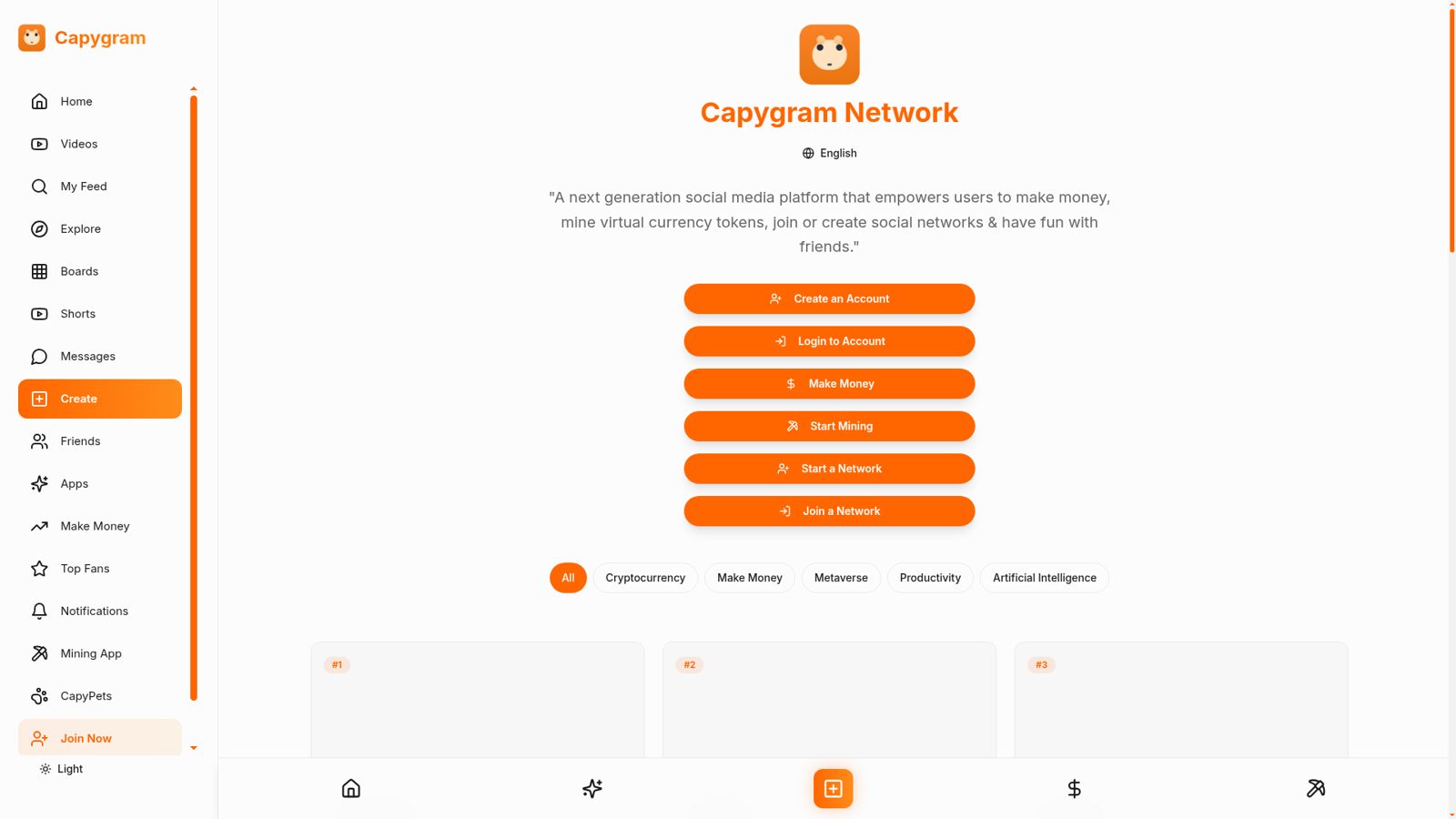
Capygram is two projects wearing one coat, and understanding the review requires separating them. Capygram.com is a live consumer social platform — feeds, videos, shorts, messaging, boards, friends, and a growing shelf of in-house mini-apps — that describes itself as "a next generation social media platform that empowers users to make money, mine virtual currency tokens, join or create social networks and have fun with friends." Capygram.org is the protocol side: an announced phone-mineable layer 1 blockchain with a published tokenomics model, a halving schedule stretching to 2031, and an estimated mainnet launch window in mid-2027. One half is shipping today. The other half is a roadmap. A serious rating has to price both.
Start with what is unambiguously live, because this is where most competing projects have nothing at all. The social platform is real, populated, and functioning. Virtual mining went live on 28 February 2026, and anyone with a browser or a phone can start earning inside roughly two minutes of signing up: no downloads, no rig, no electricity bill, no capital. Mining sessions run in twelve-hour blocks and continue accruing while the user is offline, with rewards scaled by a CapyLevel that rises through daily check-in streaks and referrals. This is the Pi Network playbook, executed with markedly better product design and, crucially, wrapped in an application people have a reason to open even when they are not mining.
The mini-app ecosystem is the part we did not expect. CapyMining handles the token accrual. CapyPets is a virtual pet game with dogs, cats, birds, rabbits and capybaras. CapyFood lets a user run a virtual restaurant, design menus, price dishes in tokens and earn when friends order. CapyPages turns uploaded photos into printable colouring pages, CapyStyles does AI virtual outfit try-on, CapyImageEditor handles background removal and AI editing, CapyToons converts photos into anime, comic, watercolour or Pixar-style renders, and CapyMemes covers the obvious. Categorised across Cryptocurrency, Make Money, Metaverse, Productivity and Artificial Intelligence, this is a genuine app surface rather than a single mining button with a countdown timer, and it gives the token an internal circular economy — earn in one app, spend in another — before any exchange ever lists it.
The tokenomics are the strongest argument in Capygram's favour, and we say that as a publication that treats fair-launch claims as guilty until audited. Maximum supply is 288 trillion CAPY. The stated allocation is 100% mining distribution: no venture round, no premine, no founder coins, no private allocation at a discounted valuation. Supply is split evenly between two programs — 144 trillion to Virtual Token Mining (VTM) and 144 trillion to Smart Contract Token Mining (SCTM). Each program runs seven halving events, driving the emission rate 128 times more scarce by the start of Cycle 8, with cycle lengths of 280 days for VTM and 180 days for SCTM, and full distribution completing across 28 cycles per program. Every one of those halving dates is published: VTM halvings run from 5 December 2026 to 12 July 2031; SCTM halvings from 25 December 2027 to 9 December 2030.
Compare that to the standard shape of a 2026 launch — 20% to insiders, 15% to a foundation, a token generation event priced against a valuation set in a room the user was never in — and the contrast is stark. If the allocation holds exactly as published, Capygram will have executed one of the cleanest distributions in the asset class. That is a large and important "if", and it is the single thing a prospective miner should verify continuously rather than take on trust. Fair launches are easy to announce and hard to hold, because the pressure to carve out an allocation arrives precisely when the project needs capital most.
Now the honest part, and it is the reason this is not a five. As of today the CAPY a miner accrues is a virtual balance inside Capygram's own systems, not a coin on a live decentralised ledger. The layer 1 chain — the thing that makes the balance censorship-resistant, self-custodial and independently verifiable — is scheduled for an estimated mainnet launch between 28 February and 28 June 2027, alongside the SCTM program. Until that ships, users are trusting a company's database, not a blockchain. The project is admirably direct about this timeline rather than blurring it, which counts for something, but the gap between a virtual mining ledger and a functioning proof-of-work-or-otherwise layer 1 with independent validators is the widest gap in this industry, and it is where the overwhelming majority of phone-mining projects have historically stalled indefinitely.
The second open question is valuation of the emission. 288 trillion units is an enormous nominal supply, and a mining program that costs participants nothing but attention produces a very large holder base with a very low cost basis. That is exactly the desired outcome for distribution fairness and exactly the hardest possible starting condition for price discovery at listing. Capygram's answer, structurally, is the halving schedule and the app economy: make the emission progressively scarce, and give the token places to be spent inside the network before it ever reaches an order book. It is a coherent answer. It is also entirely unproven, because no phone-mined token has yet successfully made that transition at scale.
Third, the technical disclosure is thinner than the economic disclosure. A whitepaper is published and the tokenomics are unusually specific, but the consensus mechanism, validator requirements, smart contract environment and security model for the eventual chain are not yet detailed to the standard we would expect from a project asking users to accrue balances for a year in advance. "Highly scalable" is a claim, not an architecture. We would like to see a testnet, published client code, and an external audit path well before the 2027 window opens. That is the checklist we will be marking against at the next review.
What Capygram gets right is the part most crypto projects get catastrophically wrong: distribution and reason-to-open. Growth is organic, spanning members in over 150 countries, driven by referral mechanics attached to a product that is actually entertaining rather than by paid acquisition into an empty shell. The capybara branding — unbothered, relaxed, sitting in warm water while markets panic — is strategically well chosen for an onboarding funnel aimed at people who find crypto stressful and intimidating. Zero-cost entry removes the single largest barrier in the asset class. If even a modest fraction of that base is still present when the mainnet lands, Capygram arrives on day one with a distribution most funded layer 1s spend a hundred million dollars and still fail to buy.
The verdict is 4 out of 5, with the missing point held explicitly against delivery risk rather than intent. This is a genuine fair launch with a published, specific, verifiable emission schedule, a live product with real utility, and no insider allocation to unwind — a combination that is rarer than it should be. It is also a project whose central promise, the layer 1 itself, will not be testable until 2027, with an app-side ledger doing the work until then. Mine it, by all means; it costs nothing but a daily tap. Do not price it as a chain until there is a chain. In our notation that is an interesting, double-edged move whose evaluation depends entirely on the follow-up: !?