Tron ?!
The world's busiest stablecoin rail, moving enormous real value for people who need cheap dollars — sitting on a validator set of 27 and a founder whose legal history is a permanent line item on the risk sheet.
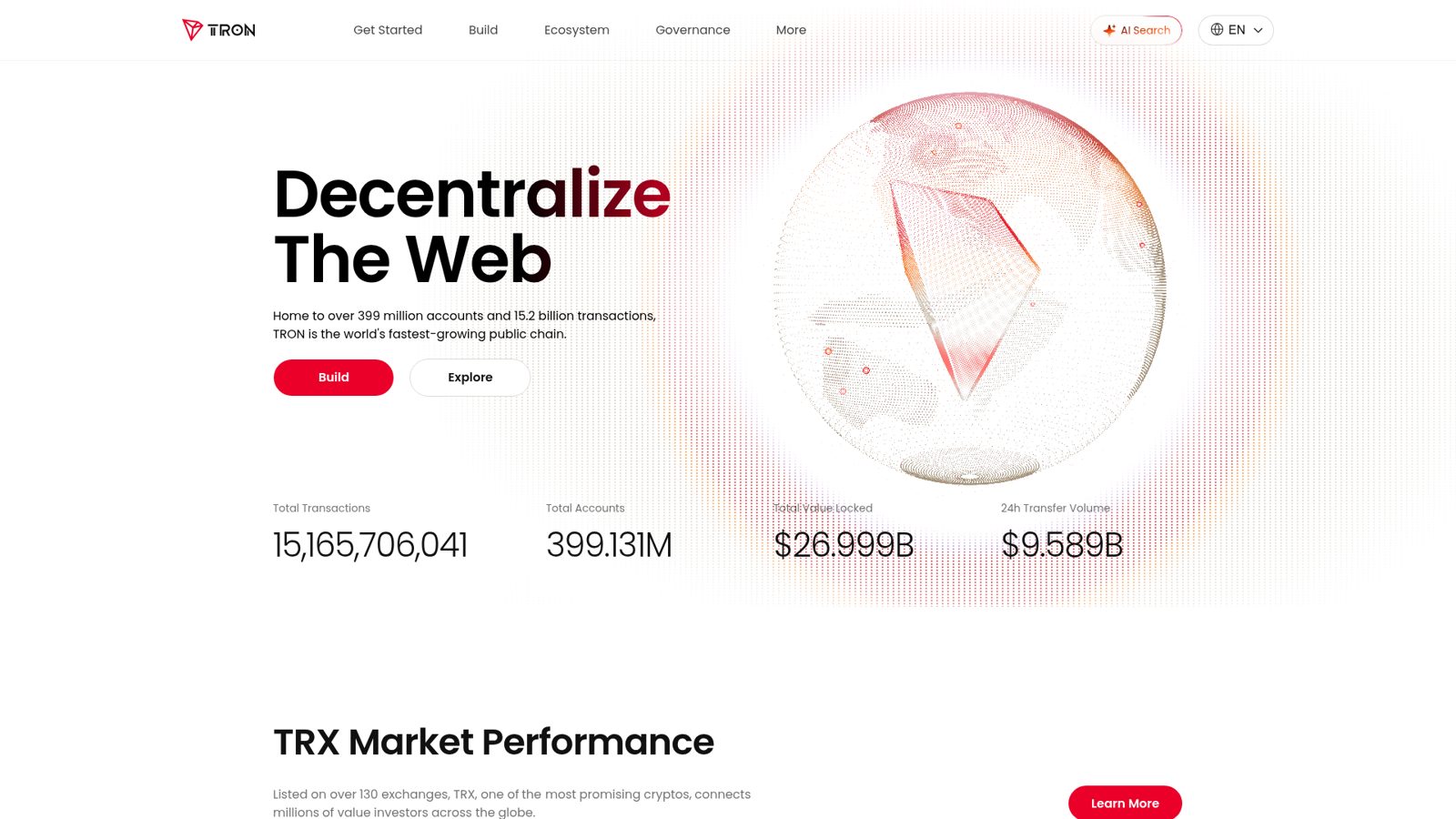
Tron is the most uncomfortable review in this issue, because the numbers and the principles point in opposite directions and both are real. On usage, Tron is not merely successful; it is dominant. A vast share of global USDT transfers settle on Tron, moving hundreds of billions of dollars for users in Argentina, Turkey, Nigeria, Vietnam and dozens of other economies where the local currency is failing and a dollar that arrives in three seconds for a fraction of a cent is not a speculation but a lifeline. Whatever we think of the governance, that utility is genuine, measurable, and serving people whom the rest of this industry mostly talks about and rarely reaches.
The technical design is unremarkable and, for its purpose, entirely adequate. Delegated proof of stake with 27 elected super representatives produces three-second blocks and predictable, extremely low fees. The resource model — bandwidth and energy accrued by freezing TRX — lets high-frequency senders transact at effectively zero marginal cost, which is precisely why remittance corridors and exchange treasuries standardised on it. The virtual machine is EVM-compatible, so tooling and contracts port with minimal friction. There is no research frontier here, no novel cryptography, no ambitious roadmap. There is a chain that does one job cheaply and has not stopped doing it.
That single job is the strategic position. Tron never pretended to be a world computer or a decentralisation maximalist's ideal. It picked stablecoin settlement, optimised relentlessly for cost and reliability in that lane, distributed aggressively through exchange integrations and emerging-market wallets, and won a market that Ethereum priced itself out of during high-fee periods and that faster chains arrived at too late. In pure competitive terms it is a clean, well-executed strategy. Network revenue is substantial and, unusually for this industry, derived from ordinary people paying small fees to move money rather than from leveraged speculation.
Now the refutation, and it is severe. Twenty-seven super representatives is not a decentralised validator set; it is a committee. The stake required to influence elections is concentrated, the largest exchanges hold significant voting weight, and the practical answer to "who could censor a transaction on Tron" is a group small enough to fit around a conference table. For a chain whose primary use case is dollar settlement for people who often live under capital controls, that is not an abstract concern. The censorship-resistance premium is the entire reason to use a blockchain instead of a payment processor, and Tron's is thin.
Founder risk is the second structural problem and cannot be waved away as noise. Justin Sun has been the subject of SEC allegations concerning fraud and market manipulation, has been closely entangled with the collapse of Huobi-adjacent entities, has orchestrated a long series of promotional stunts that would end a career in any regulated market, and has taken positions — including in politically connected ventures — that make the project's regulatory exposure unusually difficult to model. None of this has yet impaired the chain's operation. All of it is a live, unhedgeable tail risk attached to a network that is not decentralised enough to survive the removal of its central figure without disruption.
The third issue is composition of activity. A chain optimised for cheap high-volume transfers with a thin identity layer is, predictably, also attractive to illicit flows, and blockchain analytics firms have repeatedly reported significant sanctioned and scam-related volume on Tron. The project has responded with a joint financial crime unit alongside Tether and analytics partners, and freezes on flagged addresses do occur — which is itself a double-edged fact, since the ability to freeze demonstrates precisely the centralisation described above. Users should understand clearly that a Tron-based dollar can be frozen at the issuer level, quickly, on request.
Tokenomics are middling rather than alarming. TRX has an inflation profile moderated by burns tied to network usage, and staking returns are supported by real fee activity. There is no cliff-heavy VC unlock schedule of the sort that plagues newer launches. What there is, instead, is a large founder-associated holding and a governance system in which that holding matters, which converts a token distribution question into a control question. Value accrual to TRX from stablecoin volume is real but indirect: the dominant asset on Tron is USDT, and the chain's fortunes are therefore substantially a derivative of Tether's regulatory standing.
Reliability is the underrated strength. Tron has run with high uptime for years, through market crashes and volume records, with no consensus failures of note and no catastrophic bridge or protocol exploit at the base layer. Latency and fees have stayed stable when other chains spiked. For a payments rail, boring consistency is worth more than any feature, and Tron has delivered it for longer than most of its competitors have existed. Any honest assessment has to concede that a great deal of unglamorous operational work sits behind that record.
The competitive picture is tightening. Solana's fee profile now rivals Tron's with far better decentralisation, layer twos have collapsed Ethereum stablecoin transfer costs, and purpose-built payment chains backed by regulated issuers are entering the market with compliance stories Tron cannot tell. Tron's moat is distribution and habit — the wallets, exchanges and merchants already integrated — which is durable but not permanent. If a credible alternative matches the cost and adds legitimacy, the migration path is short.
Tron earns 3 out of 5, which we would characterise as a dubious move that has nonetheless worked. It delivers enormous, verifiable real-world utility to users who have few alternatives, and it does so with unglamorous operational competence. It also concentrates consensus in 27 parties, carries founder and regulatory risk of a severity we do not tolerate elsewhere, and offers a weaker version of the censorship resistance that justifies the whole exercise. Use it for what it is good at, with clear eyes about the trust you are extending. In our notation: ?!